Embodied Knowledge Workshop
Current edition
Embodied Knowledge Workshop 2026
An intensive, open-ended exploration of bodily experience. Nine sessions, 35 hours, free. Open call 15 May - 15 June 2026.
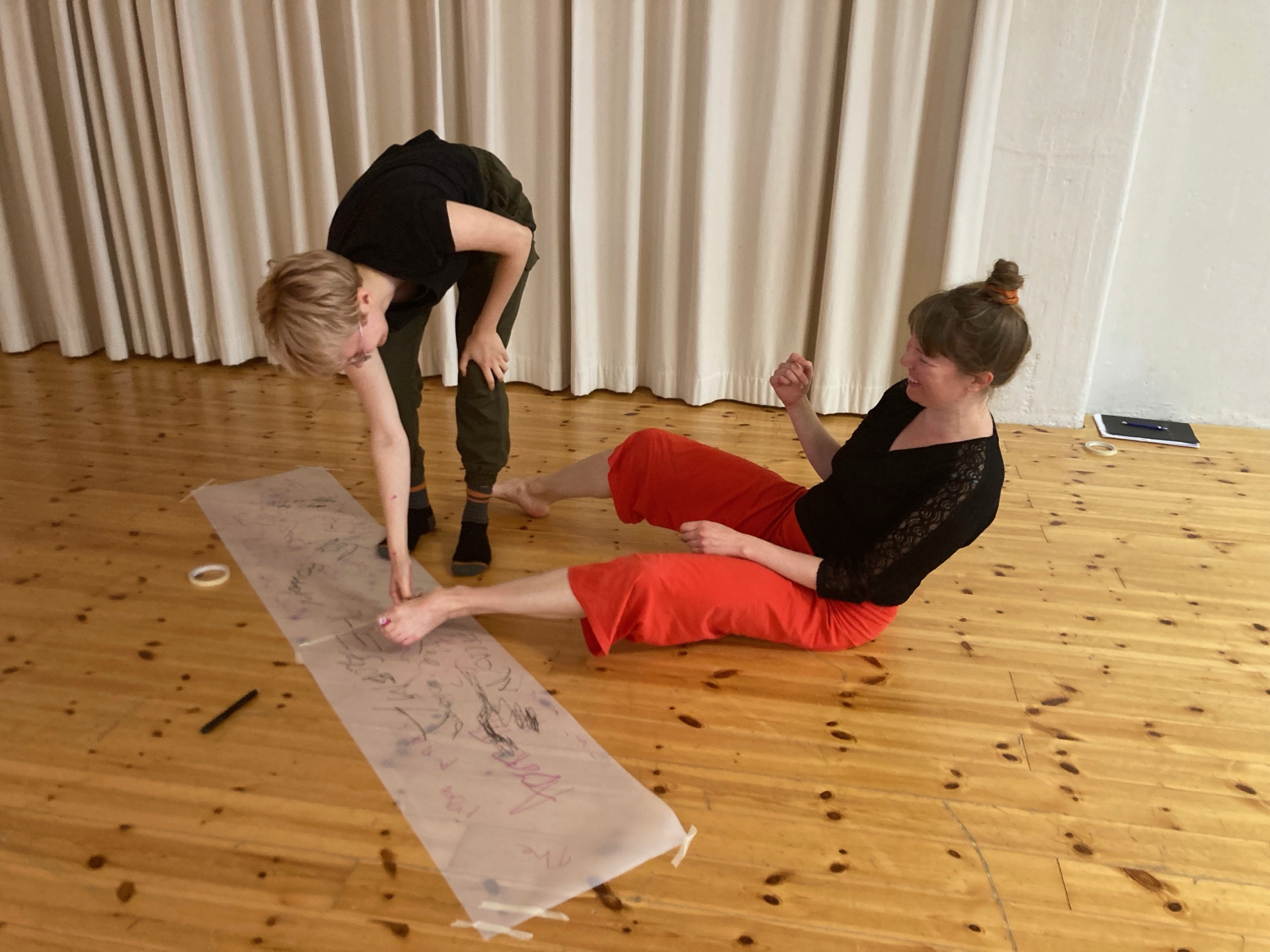
Full details and how to get involved →The Embodied Knowledge Workshop (EKW) is a process of collective search that takes this question seriously. Over nine sessions, participants explore how bodily experience — the senses, movement, gesture, interaction with others — shapes how we understand ourselves, relate to other people, and navigate the world. We work with exercises that move between physical exploration, creative writing, mapping, conversation, and short readings from philosophy. Every session is different, but there is a thread running through them: a sustained, careful attention to what happens when we slow down and listen to what bodies are doing and saying.
This is not a course in dance, yoga, somatics, or any specific bodily technique. It is not a therapeutic space. There is no performance or public presentation at the end. The workshop is for people who are curious about embodied life and willing to spend time with that curiosity alongside others, regardless of whether they come from the arts, the sciences, or somewhere else entirely. What matters is willingness to be present and to engage in the process.
Each edition of the workshop has been shaped by its specific context and group. Four editions have run in Finland (Helsinki and Turku, 2019-2024), and the exercises, readings, and focus have been unique each time. What stays constant is the commitment to open-ended search: participants are not given answers or techniques to adopt, but tools to discover what becomes visible when different ways of knowing — sensory, intellectual, creative, interpersonal — are brought into contact with each other.
Some people find the process illuminating in ways they didn’t expect. Some find it challenging. Most find it both. Previous participants have described the EKW as a space where bodily experience became, for the first time, a genuine starting point for thinking. Importantly, it has given many people an opportunity for personal growth by acknowledging and redefining their relationships with their bodies.
From participants of previous editions
It brought the subterranean, or that which is under the ground and invisible, to a kind of social reality, or it gave the imaginative a grounding in reality. And I think the combination of the text and the embodied action, being witnessed by others, was very key. — Mika, social scientist, 2024
The exercises have gently guided me towards releasing some stiffness and boundaries that I’ve carried within me for a long time, and I have slowly started to open myself up to being where I am — more intensely. — Johana, architect, 2021
Maria approaches the idea of knowledge as a gift, a discovery process and food for thought. In other words, she invited me to be bodily, mindfully, and coherently conscious, both playful and articulate. It is all about the process of self-cultivating and also sharing. — Fond, K12 educator, 2020
The experience of the workshop was intense and challenging but rewarding. Overall, I think the course served as a tool for questioning, learning and reconnecting. Not everything was clear and easy, but then, what in the arts or world would be. — Silja, cultural organizer, 2023
It was definitely very intense and at times emotionally taxing due to the trigger points and vulnerabilities it brought to the surface. But still, important realisation of oneself, body(ies), sensuous and embodied knowledge became clearer, and it gave so much inspiration and confirmation for the work that feels right and inviting for me. — Tuija, curator, 2023
The discussions and exercises in class have offered me so much valuable knowledge and ideas that I will continue to explore afterwards. Some experiences completely changed my thinking from before the workshop. — Anastasia, visual artist, 2023