Contemporary Art Museum Interventions in Finland
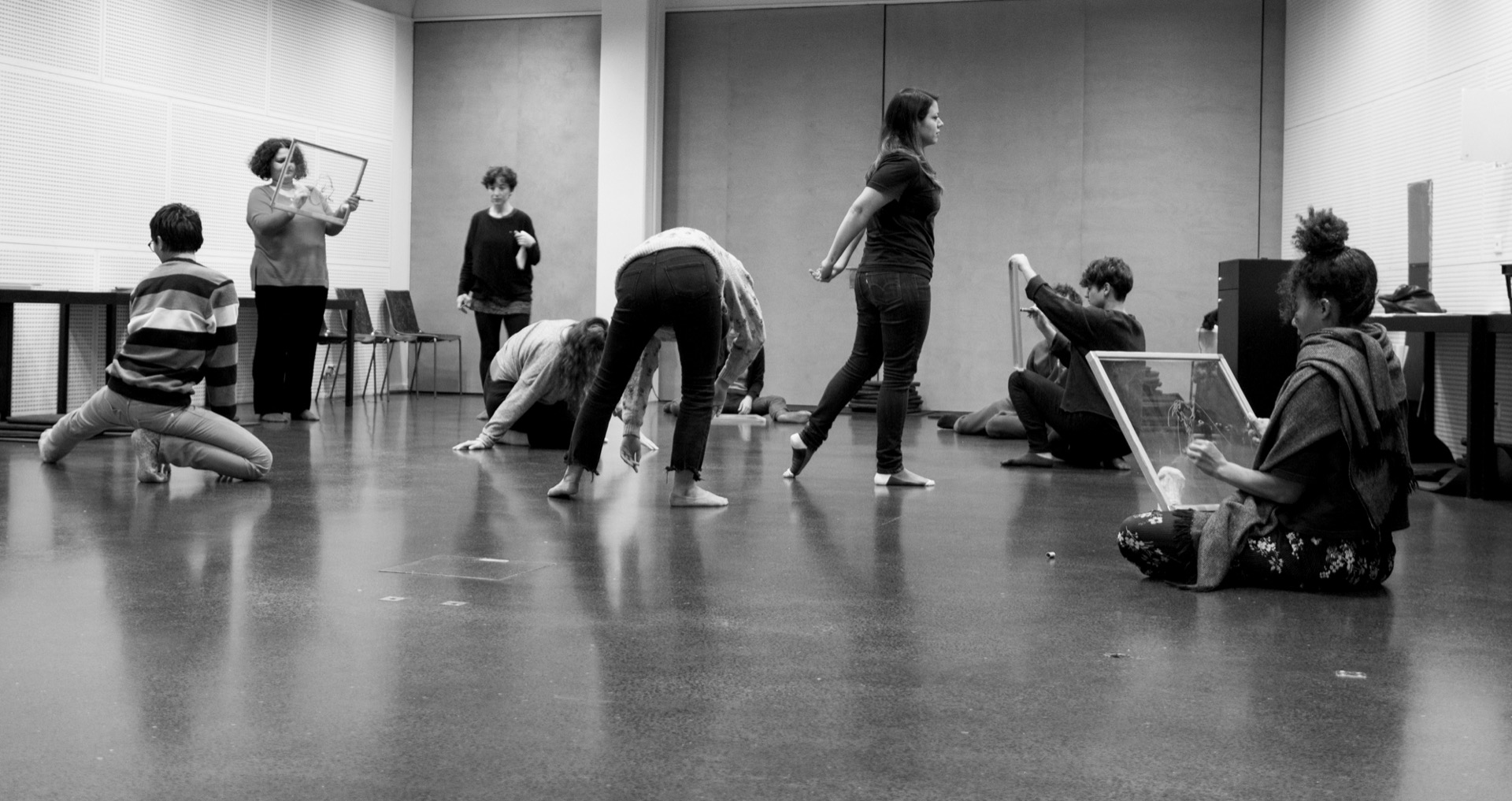
In the context of Finnish museums, I have done a few pedagogical projects in recent years: a large proposal for an engagement strategy in 2018 commissioned for the Kiasma Student Day, Performative Narratives Workshop, in Helsinki; and a participatory performance intervention for the exhibition The Men Who Fell from Earth, for EMMA Museum of Modern Art, Espoo (as part of a collaboration of Aalto University with Helsinki Theater Academy) in 2019.
Kiasma - Student Day - 2018
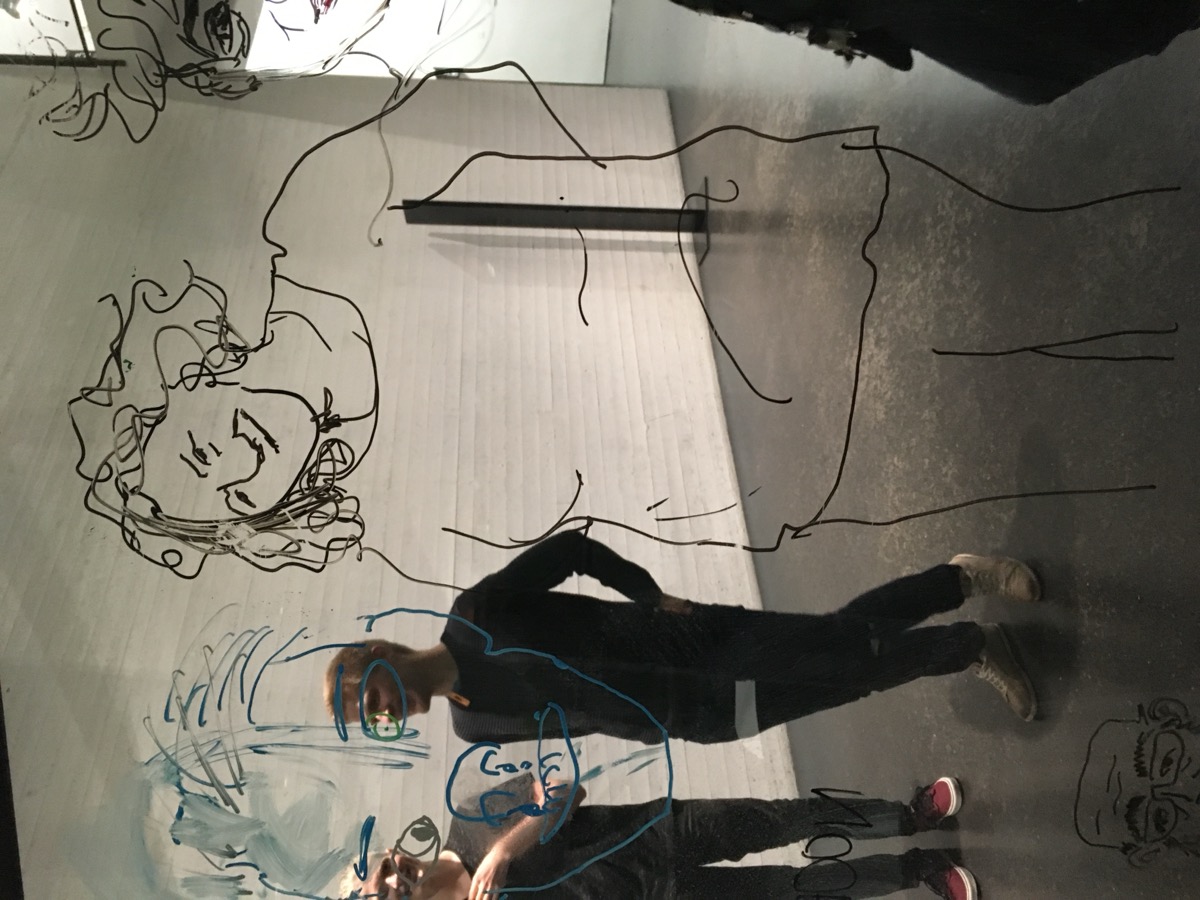
I received a commission for audience engagement for the Kiasma Contemporary Art Museum Student Day in Helsinki, a day when the museum is open for free to students of all ages and often includes additional programming giving opportunity for a more interactive connection with contemporary art forms. The proposal was called the Performative Narratives Workshop and included two intensive (3-hour) workshops for adults, and a participatory installation for the broader audience.
The workshops were offered to groups of up to 15 adults and young people, required registration, and focused on embodied explorations. I offered them with the title The Meaning in Between, and proposed to focus on bodily gestures, reflecting on how they are read, their intended and unintended meanings and appropriations. I also introduced performance art exercises as unscripted actions spurring imagination and delving into the stories our bodies may tell. Using a simple technique of instant drawing the workshop explored the body in action, addressed its social meanings, and invited bodily creativity. Participants explored improvisation with their bodies and used sketching to capture gestures, both still and in motion, to then discuss personal and cultural views around them.
The participatory installation for the large audience of the open museum day consisted of frames providing translucent canvas for sketching portraits. It hosted hundreds of attendees during 10 hours of open museum visitor flow of the Students Day. The quick performative drawing experiment was installed in the main hall of the first floor, and offered a low-threshold participation in 20-minute workshop sessions to the public. This was not a standalone prop; it was actively led by turns by a Kiasma educator and/or me inviting participants to draw the instant portraits of each other, going past the common apprehension about drawing skills or techniques, and redirecting attention to discuss what surfaced from the personality and the identity of each model on the glass.
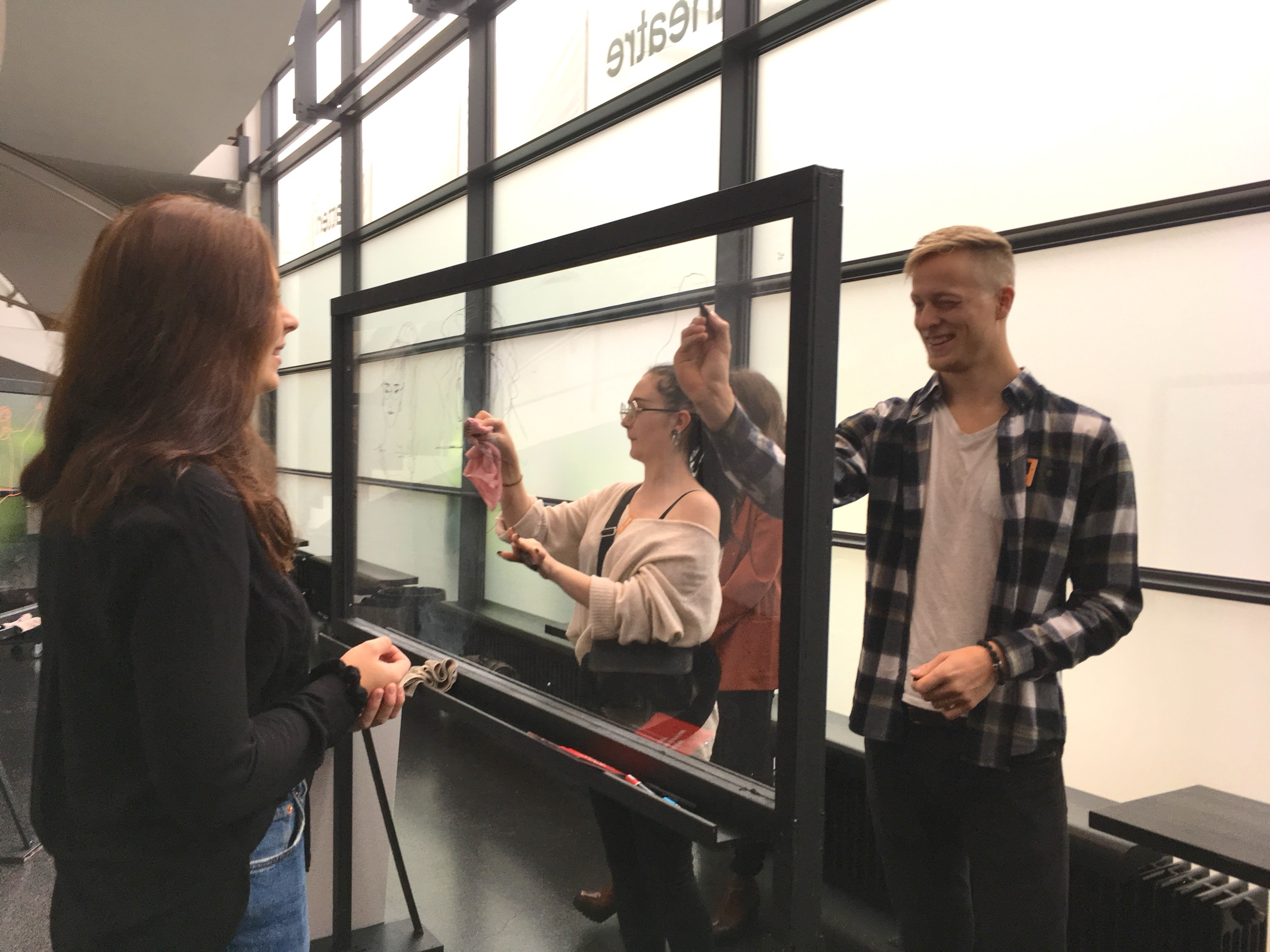
See the full Kiasma gallery below ↓
EMMA - Free Falling - 2019
A series of creative interventions using improvisation and participation was proposed for the large gallery of the exhibition The Men Who Fell From Earth by Tal R, Daniel Richter and Jonathan Meese at EMMA museum in Espoo, Finland during May 2019. The artists had created an irreverent and playful exhibition, one that proposed a presumed radical gesture to contemporary life, but once set inside the white box the audience could not join in their game. Together with a group of six mediators from visual and performing arts we designed a framework to facilitate and enable the expression of the audience, bringing an assortment of theatrical props in connection with the objects and installation vitrines featured in the show, asking visitors about what the exhibition stirs in them aesthetically and critically, and getting them involved in artistic explorations where they could also be playful. As part of this intervention, I proposed a participatory and reflective form of art mediation focused on performative text to activate the large collection of painting, sculpture and installation.
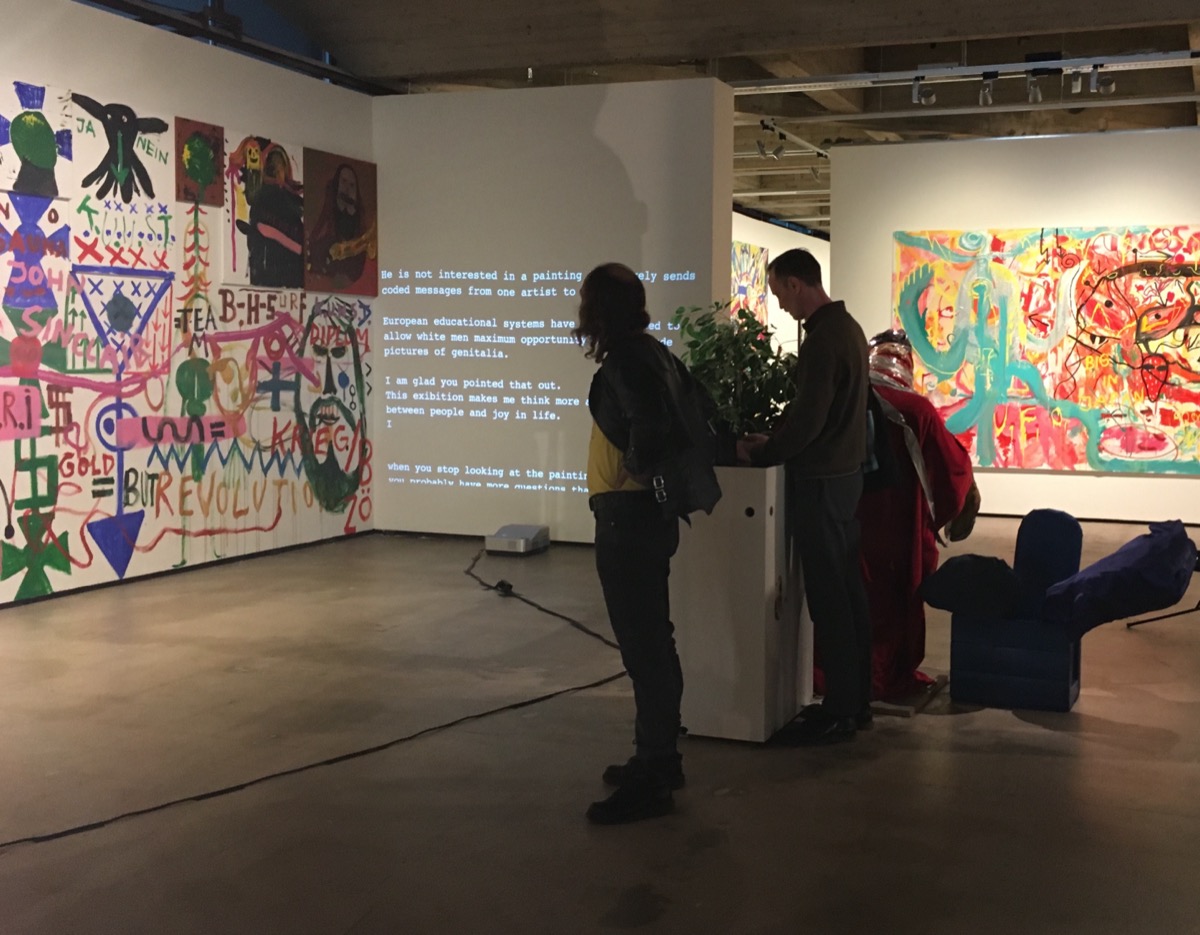
The Free Falling intervention operated with a series of six stations we developed collaboratively, located in different spaces within the large collective exhibition, activated on Friday evenings for the free-entrance hours. Visitors were introduced to the intervention and the stations briefly at a station hosted by a performer ventriloquist, and from there invited to engage freely with the rest of the stations and the art show during their visit. Each station brought to life different modes of interaction with objects and ideas, using bodily movement and games of composition and free association with props akin to those that Tal R, Richter and Meese engaged with to produce the exhibition. To the overlap of authorship they constantly play with, our team of mediators added the overlap of voices, gestures, and interpretations of artworks by the audience. Participation was encouraged but not forced: the audience could decide the extent of their engagement with the intervention or pace around the gallery independently.
The station I proposed was based on participatory writing engaging with the varied discourses this exhibition builds upon and the ones it eclipses or neglects. Based on my own research of the three artists’ perspectives about contemporary art, culture and society, I attempted to enter the discursive space the artists themselves occupied, to critically and playfully open it to the audience. Standing with a computer on a small plinth, I typed out different quotes from interviews or statements of the three male artists, allowing the text to emerge slowly during the event, and interlocking challenging questions addressed to them. My writing was shared with visitors through a real time projection on the wall. Every now and then, I would engage in conversation with visitors and invite them to type their own questions and ideas. Any visitor could read them in the exhibition space and may respond anonymously to them, joining in the live text also with their phones using a QR code. Writing may be done in any language and would display unedited in the live projection for the rest of the audience to read. The station gave room for people to elaborate on what was interesting, striking and/or difficult about these artworks, and opened a way to address the uneasiness and puzzlement the raw aesthetics of the show created for many people in the general audience. Below are two fragments from the textual intervention.
“Why did they think of that Bowie movie?
was it the symbol of complete incomprehension,
of total ambition and total defeat…
total desperation?
perhaps artists have this feeling of
being trapped inside a world that they nonetheless need to survive on,
and
at the same time
they despise entirely.
You use the world,
but at the same time you hate what it gives you.
you can only laugh at it, get drunk, like Bowie’s
character… get completely frustrated
then your drunkenness with the world becomes
the very trap that keeps you tied to it.”
“PLAYGROUNDS
GRAVEYARDS
SEXCLUBS
BACKYARDS
these residual, at times dark and lonely, marginal places in everyday life
places for loosing track of time
getting rid of the pressure of being on the clock,
places for giving in to fantasy
sad spaces at times
for those who don’t quite fit in the public view,
places for forbidden but also silly actions
one might not admit to doing later,
also hiding places for lost souls,
and secret games.
there is a lot of anxiety, at the same time
Artists are choking on the world
as they try to eat it.
They are wanting to squeeze its rich juices
but it seems they are just vomiting its poison.
Specially here, in this corner.”