Creative Time Summit - Stockholm
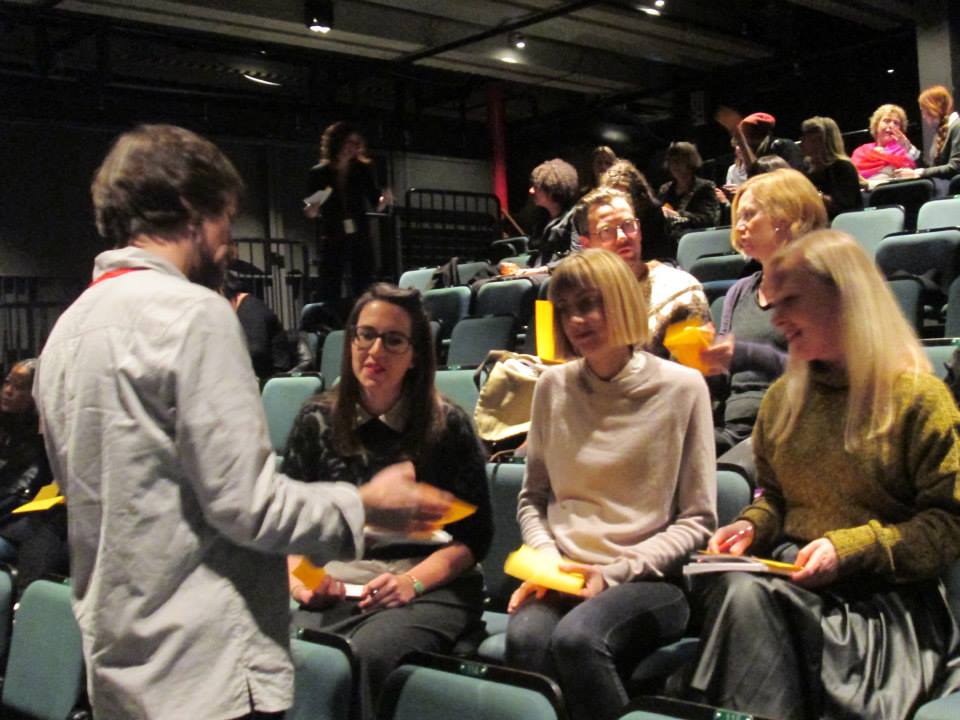
I was hired by New York nonprofit Creative Time to develop the audience engagement strategy for the CT Summit in 2014, taking place at Kulturhuset in Stockholm. Organized around the themes of nationalism, xenophobia, migration, and climate justice, it was a large-scale event providing an experimental setting for facilitating critical dialogues between the art field, the academic community, and broader publics in the Nordics. I designed the strategy, facilitated part of it myself, and trained a group of local mediators to support the implementation.
The main challenge was creating participatory tools of quick application that could work simultaneously with a five-hundred-person auditorium throughout two days of conference, going beyond the traditional separation between audience and speakers. Every activity was designed in direct relation to the subject matters of each section of the Summit, giving a lot of freedom to participants while achieving reflection and prompting genuine insights—rather than fast games built on automatic responses. Three activities ran across the entire two days developing as the agenda unfolded; a second set took place in twenty-minute slots associated with each conference section. Some activities harvested questions and concerns from the audience; others rendered visible outputs to share with the entire auditorium on the spot—hopefully influencing the reflections taking place on stage—and most generated curated online galleries afterwards. All dynamics were announced in advance, completely voluntary, and facilitated by trained mediators working with groups of no more than twenty people, who received a two-session workshop before the event to grasp the aims, logistics, and technical processes involved.
The Commons Passport
One of the strategies running across the full two days was the Commons Passport—a booklet handed to attendees alongside their entrance credentials, designed in direct relation to the Summit’s themes and working visually and conceptually against the legal function of a passport as a tool of control, identification, and surveillance. The booklet was a critical object in itself: its cover bore the stamp “No one belongs here more than you,” and its internal structure subverted every convention of official identity documentation. Where a passport records a fixed identity, the Commons Passport asked participants to trace the trajectory from their birthplace to wherever they are today, mapping not a nationality but a life in motion. Where a passport issues and expires according to state authority, this one asked: when did you first become aware of who you are, and what gives you freedom or takes it away? The pages invited reflection on where you feel a sense of belonging and why, on the things and places and people that resonate with you now, on where you were not free or welcomed or didn’t dare to go, and on who you could still become. The concept of the commons was central to its logic: refusing the distinction between locals and immigrants, the passport proposed that we all share a common human ground. It was structured to highlight identity is a moving, living, conflicting trajectory intersecting others, and that borders and nation states are constructs imposed from the outside. During the Summit, mediators facilitated small group conversations around the booklet’s prompts, moving participants from private reflection toward collective debate, while a stamping station in the lobby allowed participants to mark their passports during breaks with slogans and designs related to the Summit’s themes. The passport gave that premise a physical, personal, and accumulative form that participants carried and added to throughout the two days.