Visual Arts Journal ERRATA#
Published since 2009 by the Visual Art Offices of Bogota Capital District: Instituto Distrital de las Artes (IDARTES) and Fundacion Gilberto Alzate Avendano (FUGA).
ERRATA# was an initiative of Bogota’s public arts office (IDARTES), issued two times a year and aimed at fostering and disseminating research, creation, circulation, exhibition, education, curatorial work and related activities of contemporary visual arts in Colombia and Latin America. Supported by national and international editorial academic committees curating the topics, each edition addressed in its nearly 300 pages a critical theme of the art field featuring six main authors or scholars, two of them as guest editors (one Colombian and one international), and included a Dossier with a selection of national and international artists, an Interview with a reputed international author, and critical reviews of relevant art events and book releases.
As the Editorial Coordinator between 2013 and 2016, I co-curated the selection of authors and collaborators, organized the academic committees, managed communication with authors and supervised the edition and design process (Issues: #10, #13, #14, #15, #16). I was also part of the editorial team of the early editions (doing the copyediting for #0, #1, #2, #9).
I coordinated and hosted four international ERRATA# colloquiums (2011-2013). The colloquiums were held 3 times a year, with over 1500 attendees per edition. In them, I coordinated, curated, and facilitated panel discussions of specialized agents of visual arts, theory, and history from the Latin American field of art. The role had a significant academic weight in ensuring accessibility of art discourses and the dissemination of art debates for general audiences in the capital of Colombia and within Latin American contemporary art debates more generally.
I developed a strong interest in critical art mediation as I grasped contemporary art’s particular way of addressing reality beyond representing beautiful forms, wanting to confront the viewers and relate to their daily life, moving them to reflection. The contact with these ideas quickly shifted my core professional interest from publications to critical gallery education and exchanges. This is also why, for the last issue of ERRATA# I coordinated, I proposed the topic of knowledge and power in art spaces to the academic committee, bringing together a series of authors and artists I had come across in my research on critical mediation, including Carmen Morsch, Janna Graham, Pablo Helguera and Nora Sternfeld.
ERRATA# 16: Knowledge and Power in Art Spaces
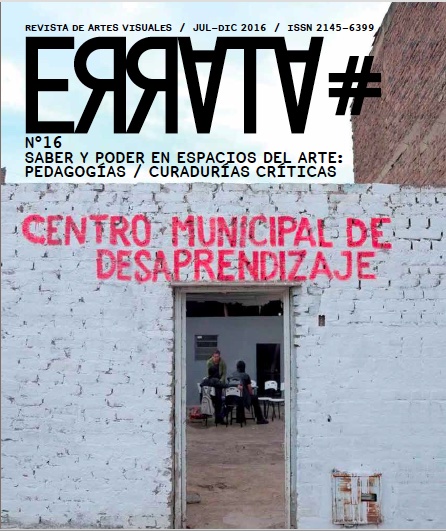
ERRATA# 16: Knowledge and Power in Art Spaces: Critical Pedagogy/Curating addressed debates on contemporary art and its audiences by analyzing the mediations shaping art’s legitimizing narratives, spaces and ways of circulation, and engagement processes that go beyond the limits of the art field. Through the voices of several collaborators, Colombian and international, the issue explored the politics of seeing/interpreting emerging from the various roles in the art world (artist, curator, educator, critic, spectator), art dissemination policies and cultural policy at large. Cultural literacy, tensions between art consumption and engagement, art as social practice, power inside art institutions were foregrounded in the issue. An important place was given in it also to postcolonial and critical mediation practices, curatorial projects of critical bent, the aftermath of the “educational turn”, and participative or open curating.