Public Program of Bogota's Visual Arts Office - Galería Santa Fe
The Institute for the Arts of the Capital District (IDARTES) of Bogota is a division of the Mayor’s office organizing large festivals, a system of art grants, and running several public art venues in the city. In that frame, Galería Santa Fe has been Bogota’s main public gallery for contemporary art since 1972. The exhibition program of the gallery provides a year-round series of shows, with the artworks resulting from art production grants, among them, the Luis Caballero National Art Award (for senior Colombian artists) and of other public contests for young artists, art researchers and educators. The programming responds to a cultural policy that supports art creation and research, emphasizes audience engagement and encourages local art debates.
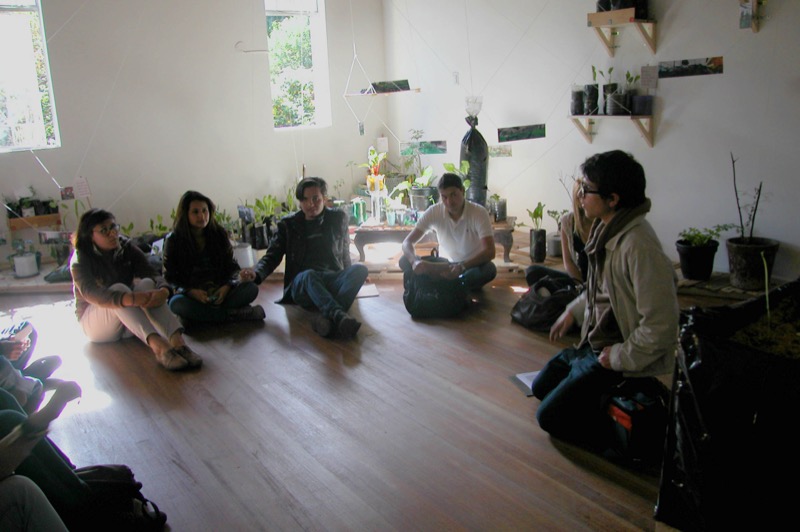
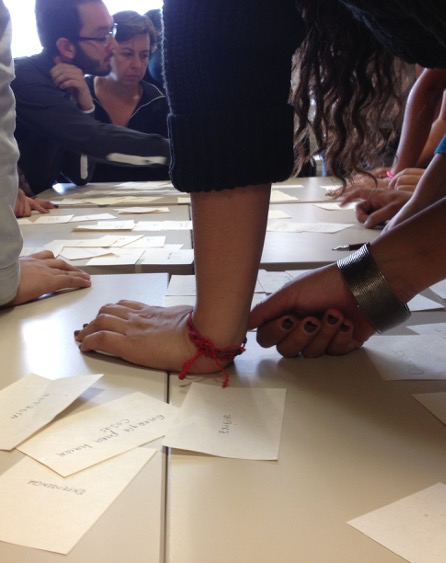
I ran the public program for Galería Santa Fe for two years as Coordinator of Education and Research Programs. This included designing educational tools and complementary activities intended to promote reflection and engagement with the monthly art exhibitions with varied audiences. My job encompassed running Escuela de Guias (a team of 20 interns, art students and educators giving the tours and workshops for public schools, families and specialized audiences). I provided training for them to design, test and run audience engagement strategies for the art shows. I also organized lectures, seminars, and conferences year-round with guest curators, critics and artists, and edited the yearly publication of research grants on Colombian Art History and Criticism.
In this context, facilitating audience’s understanding of art had to be in balance with providing a compelling experience: it was important to explain art concepts and ideas accurately, but my aim was to build a genuine dialogue with every group and a meaningful connection with art (engaging them personally, intellectually and creatively). In fact, I realized that one thing would not be achievable without the other: real learning only happens when what you learn matters.
I also focused on the challenging task of helping fulfill the promise contemporary art often makes of arriving at a horizontal dialogue of art and life, where transformation of reality is a key element. This less hierarchical rapport of cultural products and their audience was supported on constructivist and critical pedagogies I was familiar with through my ethical and political studies.
See the full Galería Santa Fe gallery below ↓
Art Mediation Laboratory 2011-2013
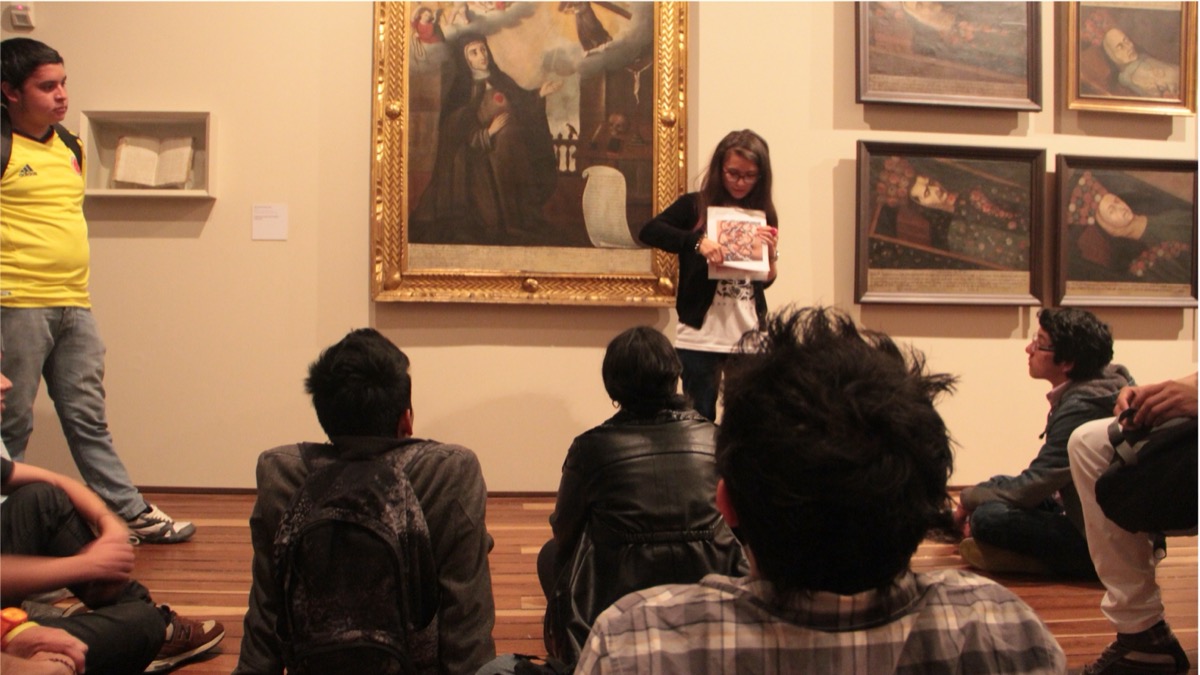
After training the guides and interns for large public art exhibitions my teaching methods diversified greatly beyond the textual and discursive components. I became interested in teacher education itself—how could my students develop rich facilitation skills and confidence to support discussion and prompt creativity of audiences of widely varied education levels and cultural backgrounds?
After three years working in this capacity, I developed and implemented a fully structured syllabus as part of the city portfolio to support the visual arts sector: the Art Mediation Laboratory. It was a 120-hour certified training program for art educators and facilitators selected through an open call. I designed the selection process and invited curators and artists to teach in some of the modules. The curriculum design included a corpus of theory and criticism of contemporary art exhibitions, delving deep into critical museum studies, as well as discussing what meaningful interaction and participatory strategies with the audience could entail in varied local contexts: from small galleries, to museums, to community spaces with temporal art shows. Bringing critical pedagogies in was vital to move away from the traditional “guide role” of lecturing visitors, and towards transformative dialogues. As part of the project, we edited a book extracting the approach to contemporary art, facilitation methods, and best practices, and the reflection on the experiences of student’s projects. The book was released and distributed freely to three hundred venues/art educators in the city (see Villa 2014a).
Many of the facilitation and participatory practices I developed in these years in Bogota were analyzed and shared in articles I published in Spanish in Buenos Aires, Bogota and Costa Rica (for Teoretica and the Modern Art Museum of Buenos Aires MALBA; see Villa 2015, 2016a, and 2016b).